We talk to the historians James Barr and Elizabeth F Thompson about how the Syria‑Jordan border came into existence
26 MARCH 2022
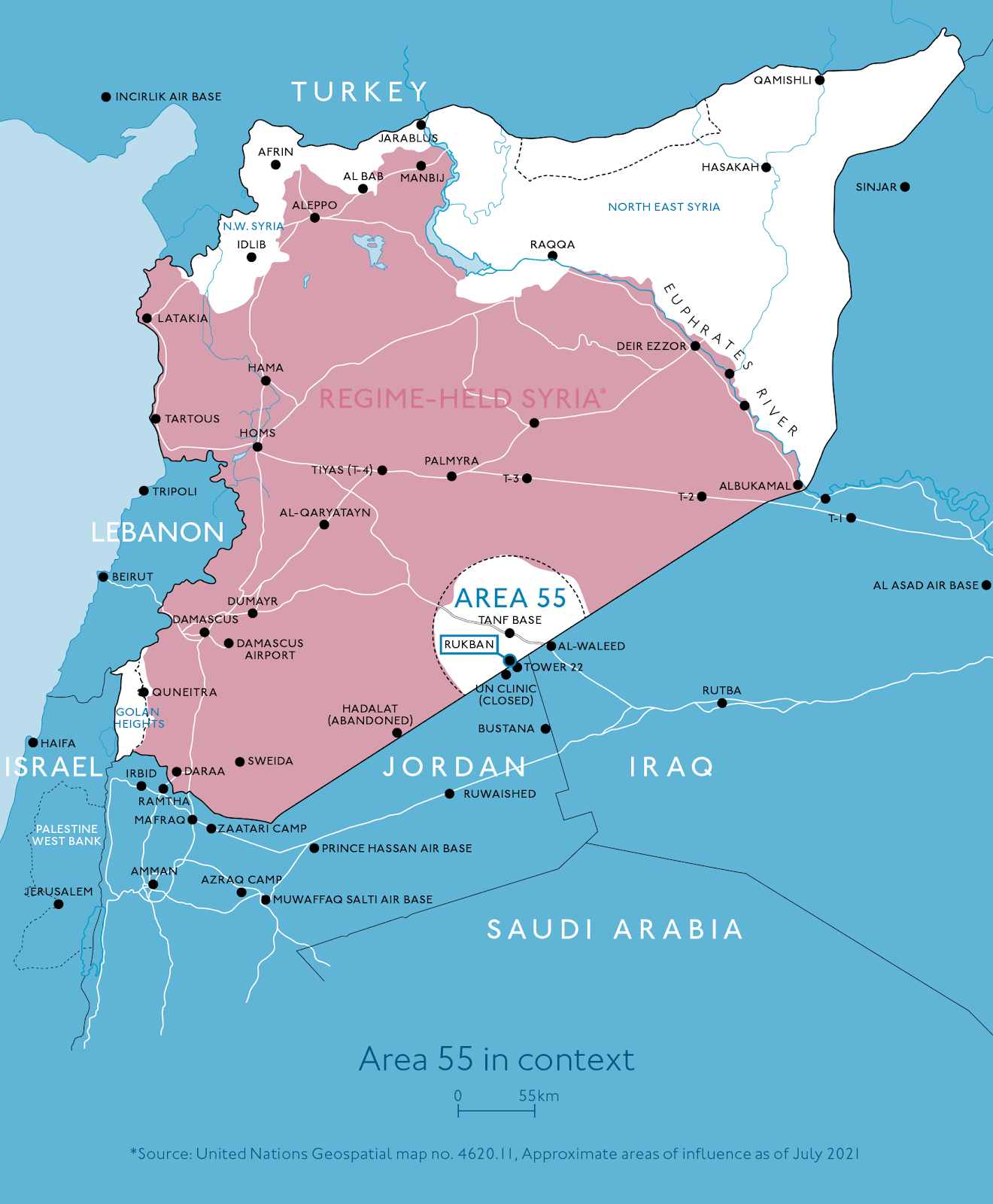
At the beginning of the twentieth century, there was no border at Rukban, no frontier post and no barrier. Yet today, at this remote point in the desert, thousands of people find themselves trapped by
a line drawn on a map. At Rukban, lines in the sand are now a physical reality. This area is referred to as ‘the berm’ because of the long embankments that governments have built across the desert along both sides of the frontier.
How did the border come to be? Two currently available books combine to give a rich understanding of the border’s origins,
A Line in the Sand by James Barr, and
How the West Stole Democracy from the Arabs by Elizabeth Thompson. We talked to both authors about how those events of a century ago came to impact people’s lives today.
The story goes back to the First World War, and a fateful decision in 1914 by the leaders of the Ottoman Empire to join in the war alongside the Central Powers: Germany and the Austro-Hungarian Empire. Against them were the Triple Alliance of France, Britain, and Russia.
The territory of today’s states of Syria and Jordan had been part of the Ottoman Empire for four centuries. In January 1916, British and French officials held secret talks in London to plan how they might divide the territory between them after the war, and a new borderline was pencilled in, exactly where Rukban camp sits today. The deal that resulted bears the name of the two negotiators, Sir Mark Sykes and François Georges-Picot.
Today, the Sykes-Picot agreement is remembered as an act of European arrogance, and also as a betrayal of Britain’s allies on the ground. At the time this secret agreement was made, the greater part of the war was still to be fought, and other British officials in the Middle East were simultaneously offering Arab leaders the prospect of an independent state if they revolted against the Ottomans.
For his book,
A Line in the Sand, James Barr searched British and French archives to understand the actions of the two governments and the individuals working for them. Elizabeth Thompson went to Arabic sources for her book,
How the West Stole Democracy from the Arabs, to see how at the end of the First World War, Arab nationalists formed a broad political coalition in Damascus to build an independent state across what is now Syria, Jordan, Israel, Palestine, and Lebanon. In 1920, these state builders were abandoned by Britain, and the new Syria was militarily occupied by France.
This history does more than just explain why there is now a border at Rukban. It tells an earlier story of how internal repression undermined and broke apart a centralised state, leading to foreign occupation. And it gives a precedent for how external military support was seen as necessary by Syrian forces seeking freedom, and how that dependence undid their cause.
1914-1918
As the Ottoman Empire readied for war, one of its top leadership, Cemal Pasha, was appointed both Governor General of the Syrian district and commander of the 4th Army. He had two tasks, to maintain order in Syria, and to attack the Suez canal in Egypt, which was under British control.
Ottoman authorities raided French and British consulates in Beirut and Damascus. France’s consul in Beirut, one François Georges-Picot, had already departed for Europe, but he left behind files of correspondence with Arab army officers, lawyers, journalists, including both Christian and Muslim campaigners for Arab autonomy. Cemal Pasha used these documents to justify military trials of several of those named, and on 21 August 1915, eleven people were hanged in Beirut.
In the face of this repression, Arab nationalists in Damascus agreed a plan with Sharif Hussein in Mecca to seek an independent Arab state. From Mecca in the Arabian peninsula to the south, up to the cities of Beirut and Damascus and beyond, Arab political representatives had experience of working together, Elizabeth Thompson points out, ‘Particularly from their common experience in Istanbul during the years before World War One when they had an elected government, and where an Arab caucus, if you will, formed within the Ottoman parliament, and where they had simply been asking for a kind of local rule.’
A restoration of the Ottoman parliament in 1908 had been undermined by a series of coups. The Arab Congress of 1913, held in Paris, had called for greater autonomy for Arabs in the Empire through decentralisation, and for Arabic to be included in the educational and judicial systems. The Empire’s ruling CUP party, the Committee of Union and Progress, saw decentralisation of power as a threat to the Empire, and so opposed any politicisation of ethnic identities that might lead to decentralisation.
So, Arabs both in Syria and in the Arabian peninsula had a common cause, Elizabeth Thompson tells us. ‘Those who ruled the government saw themselves as a Turkish-defined ruling elite, and Arabs were being excluded from so-called federal government,’ she says. ‘I use the term from American politics precisely because they were quite interested in American federal-style government, and that is what they had been looking for.’
But the reassertion of centralised control from Istanbul made it clear this programme was dead, and so those who had been calling for more local control within the Empire came to seek independence. ‘Now, that’s all well and good,’ Elizabeth Thompson says, ‘But they didn’t have an army, and so they accepted a deal with the British in 1916.’
What was in it for the British? According to James Barr, none on their side initially expected the Arab revolt to really go beyond the Hejaz, the western region of the Arab peninsula. But at the start of the war, the Ottoman Sultan had called on Muslims worldwide to join in a jihad against the Triple Alliance.‘The clever idea in Cairo amongst the British was, what if we encourage the Sharif of Mecca to rise up?’ he explains. ‘Clearly, Mecca is very important, and if we can show that the Sharif of Mecca does not agree with the Sultan, then we’re going to blunt the threat of this jihad.’
Double dealing
Between August 1915 and March 1916, Sharif Hussein agreed terms for the British to support a revolt in the Arabian peninsula with the British High Commissioner for Egypt, Henry McMahon in Cairo.
Then on 6 May 1916, the Ottoman Governor General ordered a second round of hangings in Damascus and Beirut. He exiled five thousand Syrian families to Anatolia, and transferred Arab troops from the region to avoid them being turned against the Empire.
And then on the 10th of June, Sharif Hussein launched the Arab Revolt in Mecca.
What Sharif Hussein didn’t know was that parallel with his negotiations with McMahon, British officials in London had been negotiating a conflicting deal with French diplomats to divide greater Syria between their two empires. When James Barr tells this part of the story, he begins with Sir Mark Sykes, whom he describes as hugely charming, persuasive, a forceful personality. A Member of Parliament since 1911, Mark Sykes had written a series of books on his travels in the Middle East before the war.
Sir Mark was invited to a Cabinet meeting in Downing Street in December 1915, and given the chance to play Middle East expert to the British government. ‘At a time when this whole crisis with the French had blown up,’ James Barr explains. ‘And the notes he took are still there in the archives,’ he says. ‘It’s three or four pages of handwritten text.’
The trigger had been the Gallipoli landings, the British attempt early in 1915 to knock the Ottomans out of the war, James Barr tells us. ‘The French were very suspicious of British motives for launching the Gallipoli campaign,’ he says. ‘For France, the pressure was all about getting the Germans out of France. That pressure didn’t exist in Britain because we weren’t fighting on British soil, but it certainly existed in France.’
When the French then discovered that the British had begun secret talks with Arab nationalists without telling them, they were even more unhappy. The British government, however, was more concerned with the domestic issue of how to bring in conscription.
Sir Mark Sykes, then, had an audience who were eager to find a way of putting their problems with the French to one side. ‘Like so much of what goes on in the Middle East,’ James Barr says, ‘It’s all to do with domestic or foreign policy concerns which really affect other parts of the world.’
The written record gives a vivid picture. A map of the region was presented, and Sir Mark said, ‘I should like to draw a line from the E of Acre to the last K in Kirkuk,’ dividing the Middle East into British and French territories.
‘The key thing that was motivating Sykes was India,’James Barr explains. ‘It was keeping any other rival power out.’ The assumption was that Britain would win the war, and allies would become rivals again. ‘And so the key strategic need, in Sykes’ thinking, is to keep France and Russia away from the seas that lead from the Middle East to India.’This is why he marked out territory for Britain from the Red Sea to the Gulf. ‘The phrase he uses in the discussion, which is minuted, is “a belt of English-controlled country.”’
With the approval of the British Cabinet, agreement now had to be reached with the French government. The negotiator sent by the French was François Georges-Picot. This was the same Georges-Picot who had been French consul in Beirut, and whose files had been taken by Cemal Pasha and used to prosecute Arabs who had corresponded with the consul.
‘Georges-Picot, the French negotiator, played pretty hard,’ James Barr says. And we can see this on the map where they marked their agreement on the 3rd of January 1916. The division is no longer Sykes’ wholly straight line from Acre on the Mediterranean up to Kirkuk in northern Mesopotamia. Instead the line was diverted south, assigning to French control the area which is now the Syrian governorates of Quneitra, Daraa, and Sweida. This caused the straight segment of borderline on to Albukamal to be moved by several degrees, so that it passed through where Rukban camp is today.
On each side of the line, the map further divides territory between coastal areas under direct control and inland areas under indirect control. ‘So the blue area was going to be under direct French control, and the red area under British control,’ James Barr explains. ‘And then these adjacent zones of influence, A and B, and this was the way of squaring what Britain had done with the Arabs, with the French view.’
Areas A and B were where the Arabs were to have an element of autonomy. James Barr describes these self-rule areas as ‘tongue in cheek,’ because by controlling access to the sea, the imperial powers would be able to limit any autonomy the inland areas might have. ‘This is the inland area, where Rukban is, for example,’ he points out.
Today’s map of the Middle East is different in many respects to the Sykes-Picot map. The Sykes-Picot map should not be seen as a finished map of frontiers, James Barr argues, but as ‘a broad carve-up whereby France and Britain would rule that part of the world after the war, which is exactly what happened.’ What is so surprising is that any of the lines on the map should have survived exactly. ‘That diagonal line that Rukban sits on is the vestige of Sykes-Picot,’ he says. ‘You can see that on the Sykes-Picot map.’

Above: Map from the Sykes-Picot agreement on the future division of Ottoman territory.
Signed Fr. Georges-Picot, Mark Sykes, and dated 8 May 1916. From the memorandum of agreement:
- Arabs. — That France and Great Britain should be prepared to recognise and protect a confederation of Arab States in the areas (a) and (b) under the suzerainty of an Arabian chief. That in area (a) France, and in area (b) Great Britain, should have priority of right of enterprise and local loans. That in area (a) France, and in area (b) Great Britain, should alone supply advisers or foreign functionaries at the request of the Arab confederation.
- That in the blue area France, and in the red area Great Britain, should be allowed to establish such direct or indirect administration or control as they desire.
- That in the brown area there should be established an international administration, the form of which is to be decided upon after consultation with Russia, and subsequently in consultation with Russia, Italy, and the representatives of Islam.
TE Lawrence
In the English-speaking world, by far the most famous character in this story is a British Army officer, TE Lawrence, most widely known through the romantic portrayal of him in the film, Lawrence of Arabia.
Lawrence was an intelligence officer who in October 1916 was sent to report on the faltering Arab uprising. The French were offering aid to the Arab insurgents, and the British were debating whether to do the same.
In his book, James Barr cites documents showing that French expressions of support for the Arab Revolt were intended to put France in a position to manage and contain the uprising, rather than to allow it to thrive. The example of a successful uprising in the Arabian peninsula could threaten France’s grip on colonies in North Africa, as well as threaten their ambitions in Syria. A senior French official, Pierre de Margerie, advocated that they ‘discreetly associate’ themselves with the Arabs’ efforts to gain freedom ‘to prevent their success turning against Christian powers with Muslim possessions.’
Lawrence suggested to his superiors that British aid be directed to one of Sharif Hussein’s sons. There were four, the oldest too frail, and the youngest too inexperienced. That left two to choose between, the second son Abdullah, and the third son Faisal, who was Lawrence’s preferred choice.
‘He played up Faisal as being, you know, a kind of kingly type of character, and played down Abdullah as a bit of a waster,’ James Barr explains. ‘The reality was at that stage in the revolt, Abdullah was the only one who had actually managed to land a blow on the Ottomans. He managed to very successfully intercept an Ottoman party and rout them, and capture a lot of people and a lot of gold. He was the militarily competent one.’ But Lawrence found that Faisal, who had more self doubt, was the easier person to deal with. ‘Famously, Lawrence said, “information had better come to me for him, since I like to make up my mind before he does,” so that was why,’ James Barr says. ‘So it was rather cynical.’
The contemporaneous evidence doesn’t support an image of Lawrence as a sort of ‘great anti-imperialist freedom fighter’ during the war, James Barr says. ‘The stuff that he wrote at the time, during the war, makes it very clear that he was a British imperialist like the rest of them.’ But once Lawrence learned of the Sykes-Picot agreement, he was deeply unhappy with this deception of the Arabs whom he was now fighting alongside. ‘Firstly, he was personally in a very difficult situation,’ James Barr points out. ‘Because he was, as he wrote to his boss, trying to get them to fight for us on a lie.’
Also, Lawrence’s view changed over time. ‘By that point, he did believe also in what he was fighting for. He got to know Faisal, and they got on, and he started to feel that the British government was not holding up its side of the deal. So, he starts to think about how to wreck Sykes-Picot, and about the need to get as far north as possible before the end of the war.’
Added to this, Lawrence ‘personally loathed Sykes,’ James Barr tells us. ‘He really couldn’t stand the sight of the man who he thought was an amateur.’ Before the First World War, Lawrence’s experience of the region and its people had been as a working archeologist. ‘There’s no question he had a sense of who they were, and who they were as real people,’ James Barr argues. ‘Sykes thought of these people as people that he had seen on his travels. He had traveled extensively through the Middle East, but he’d not done a day’s work there. He was essentially an adventurous tourist.’
In 1918, in the final months of the war, Lawrence and Faisal cooperated to bring the Arab Revolt to Damascus. The first point north of the Sykes- Picot line that they aimed for was the city of Daraa. ‘It was a nerve centre of Turkish communications in southern Syria, and it also lay just inside the French zone that Sykes had given to Georges-Picot,’ James Barr points out. ‘So it had a military significance, but it had a strategic post-war significance as well. So that is why Lawrence wanted to get the Arabs in there, because he thought that facts on the ground would trump a deal.’
1918-1920
It is in Daraa where Elizabeth Thompson opens her telling of the story. On the 30th of September, 1918, following the capture of the city by his Arab forces, Faisal was holding a meeting to plan the next move.
‘The problem that they recognise, and I capture that a little bit in the dialogue that I was able to retrieve between Faisal and his advisors, there they are at Daraa, the very town where the Syrian revolt protest started ten years ago, and they have these dual instructions,’ Elizabeth Thompson says.
By now Faisal and everyone else there also knew about the Sykes-Picot agreement. ‘But the Arabs always had made it quite clear to the British that they were cooperating on condition that they would be granted control of a territory that they themselves captured, so in the conversation that Faisal has with his advisor, Rustum Haidar, he says, “We have to get to Damascus first, before the British do”—the British troops were going up the coast, they were inland a bit—“so that we can claim Damascus.”’
Britain’s Egyptian Expeditionary Forces were led by General Edmund Allenby. The Northern Arab Army, led by Faisal, was being joined by local Syrians and tribal units. The two leaders met in person for the first time when Faisal made a triumphant entry to Damascus on 3 October 1918.
Across Syria’s major cities, Aleppo, Hama, Homs, Beirut, Tripoli, and Latakia, Arab nationalists had raised their flags. But in the midst of the celebrations, General Allenby revealed to Faisal that the British government intended sticking to their deal with France. Faisal was to report to a French liaison, the General told him, and his Arab administration was to be wholly excluded from the Lebanese and Palestinian coast.
Faisal had reached Damascus first, but the British and the French controlled the coastline, as the Sykes-Picot map had envisaged. ‘I am in a house with no door,’ Faisal remarked, meaning that he didn’t have control of any of the seaports. ‘He had to have French permission to go anywhere,’ James Barr explains. ‘And of course, the French could use that in a way to make his life very difficult.’
Before the war, Ottoman rulers had seen separate identities of peoples as a threat to the unity of their empire. Now plans by the Allies to further partition territory along sectarian lines threatened the hopes of Faisal and his fellow Arab nationalists for an independent and unified Syrian state.
Both France and Britain used sectarian issues to justify their presence. The French sought to present themselves as protectors of the Christian population, while the 1917 Balfour declaration of British support for ‘a national home for the Jewish people’ in Palestine gave Britain a justification for maintaining control of the coastal approaches to the Suez canal.
In response, the Arab nationalists in Syria worked to unite different religious communities. Faisal’s proclamation of a constitutional Arab state on the 5th of October 1918 declared that it would treat everyone alike, ‘and not discriminate in its laws between Muslim, Christian, and Jew.’ He visited Christian leaders in Damascus, and offered them much needed funds for refugee relief. He travelled across Syria to build support. Speaking in Aleppo he said, ‘The Arabs were Arabs before Moses and Jesus and Muhammad.’
There was a legal ambiguity in the British role, Elizabeth Thompson points out. ‘Were they playing the role that the Prime Minister announced at the very outset of World War One, in August 1914, of upholding international law?’ she asks. ‘There’s the trope about the “scrap of paper,” the treaty that assured Belgian neutrality, which was the cause that they claimed to enter, and then there was of course, the self-interest of empire builders in Cairo and in India, who aimed to occupy that territory.’
In 1917, the United States had entered the war on the side of Britain and France. This complicated the question of what was to become of territories seized by the Allies. President Woodrow Wilson had brought America into the war while pledging support for a new self-determination of nations and peoples, and opposing the imperialism of old European powers.
‘The British and French would play along during the Paris Peace Conference with the rhetoric of self-determination that had been introduced by Woodrow Wilson, but at each and every turn that they could, worked to subvert that project,’ Elizabeth Thompson tells us. ‘Arabs were hip to this. They weren’t dupes. They understood very clearly the treacherous game and the minefield diplomatically that they were walking through, and they gave it their best shot.’
The British government was having second thoughts about the eastern end of the Sykes-Picot division, originally drawn close to Kirkuk. The Royal Navy was looking to a future of ships powered by oil rather than coal, and so the British coveted the oil reserves believed to be around the city of Mosul, on the French side of the Sykes-Picot line. British forces occupied the city in November 1918 in order to secure their own claim by conquest.
British leaders now saw some benefit in allowing a managed form of Arab self determination. Nominal independence for client Arab governments might give Britain advantage in the region, in a form acceptable to the United States.They looked to establish an Arab government in Mesopotamia headed by a friendly client—Faisal’s brother Abdullah was suggested—and they supported Faisal to represent Arab claims at the Paris Peace Conference.
At the conference, Faisal set out a claim for an independent Arab state, in the territory of today’s Syria, Jordan, Lebanon and Palestine, grounding his argument on President Wilson’s call for self-determination.
Under pressure, France conceded that former territories of the Ottoman Empire could become ‘mandates’ rather than colonies. Under a mandate from the newly formed League of Nations, a territory could be placed in trust with one or other power as a path towards eventual independence.
‘The question of sovereignty was opened in part by the idea of mandates, and by the propositions of Wilson in his Fourteen Points’—his declared war goals—‘that all people should have their own land,’ Elizabeth Thompson says. ‘Which peoples are those, and how do you define a people?’
So do people have rights as individuals, or do rights depend on being part of some kind of nation? ‘There is a very recent and new literature revisiting concepts of sovereignty that were put afloat during the Paris Peace Conference, in which it is understood that Woodrow Wilson was actually putting forward a notion of global sovereignty that was based on the individual, not on communal claims, and the idea of the nation,’ she says.
‘And so much of the criticism of that moment, that he shepherded in an era of ethnic cleansing and national claims, really should be rethought a little bit. There are scholars who now argue he was really speaking in advance of ideas of individual human rights, at this point, and that individuals had the right to choose what sort of government would rule over them.’
In her book’s account of how Woodrow Wilson’s position of principle unravelled during the talks, Elizabeth Thompson highlights the role of racism within American domestic politics as well as in international relations. Most blatantly, when the Japanese delegation to the Conference proposed that the League of Nations covenant affirm racial equality between nations, American and European governments came together to oppose the suggestion.
Arabs held an ambiguous position in the politics and law of race. Under some governments’ laws they might be considered white, and under others’ not. Faisal and his delegation would make their case by comparing themselves to Bulgarians and Czechs, Romanians and Serbs. President Wilson had declared there would be no mandates imposed on these European peoples.
‘This was precisely the period where the franchise was expanded to women, to unpropertied peoples, where the question of integrating minorities within these polities came to the fore,’ Elizabeth Thompson says. ‘There’s an interesting confluence now, speaking of my own country, of a recognition that the fight for the Black Lives Matter movement is the same fight for colonised peoples who are still disenfranchised in the world system. Particularly looking to the tolerance, decade after decade, of refugee populations in Sub-Saharan Africa, and the Middle East, and in South Asia, that is all tied together in the unfinished work of dismantling racial hierarchies, even in our thinking, and even before we devise policies.’
A side note—then as now, the world was dealing with a pandemic. Mark Sykes, who had been attending the Paris Peace Conference, was one of the victims of the Spanish Flu. He died suddenly on the 17th of February 1919, at just 39 years of age. Because he had been buried in a lead-lined coffin, in 2011 scientists decided to exhume his body in the hope of recovering samples that could help them better understand the H1N1 avian virus of 1918-19.
Rashid Rida
One person who had responded warmly to Woodrow Wilson’s ideas was Sheikh Rashid Rida. An Islamic reformer, he came from the coastal town of Qalamoun, north of Beirut, but had been forced into exile in Egypt. ‘He published a very long-lasting and still read Islamic magazine which invited readers and writers from around the Islamic world, from Morocco to Indonesia,’ Elizabeth Thompson tells us. ‘But he was seen to have this anomalous little Syrian interlude, where he dropped his pan Islamism to embrace the Syrian national cause.’ As Faisal was on his way to the Paris Peace Conference, Rashid Rida in Cairo published an issue of his magazine, The Lighthouse, dedicated to Woodrow Wilson and to the United States as instruments of God’s justice.
Also in Cairo, Syrian exiles were organising the Syrian Union Party, aiming to uniting people across regional and religious lines in an independent Syrian state. The party ‘included a full spectrum of political and religious people,’ Elizabeth Thompson says. ‘There were very secular people in that coalition, there were Christians and there were Muslims as well.’ Rashid Rida was elected vice president of the SUP, and he worked on a proposed constitution for Syria as the party reached out to Christian-dominated Syrian parties to build support.
Since writing her book, Elizabeth Thompson says she has realised that other scholars working on other parts of the world in that period describe similar political movements, ‘for example in South Asia, amongst Indians.’ And so she believes that a true history of universal human rights ‘must be rooted in these proto-colonial or colonial territories,’ and not so much in any intellectual enlightenment within Europe.
‘We still live under the shadow of colonial propaganda that had to convince the voting publics within European states that it was okay to colonise other people,’ she says. ‘And to do so, they had to show that those people were incapable of ruling and constructing governments that were ruled by law. Hence the great danger of letting democracy in Damascus stand.’
In June 1919, the Arab nationalists organised elections for a new body, the General Syrian Congress. France and Britain blocked elections in the coastal zones. Electors there nonetheless chose delegates in secret. Several members of the new Congress demanded full independence, without relying on Britain, having witnessed British forces violently suppress an Egyptian revolution earlier that year, and having seen also how British administrators were blocking any move to self-governance in Mesopotamia.
The Syrian Congress passed a set of resolutions—the Damascus Programme—in favour of complete political independence and the establishment of a democratic civil constitutional monarchy with Faisal as King, and protesting plans to grant League of Nations mandates. They sought assistance from the United States, judging it the least colonial-minded of the powers. A contested resolution accepted Britain as a second choice. Further resolutions rejected partition, rejected the Balfour declaration, and rejected the Sykes-Picot agreement.
We put it to Elizabeth Thompson that it is striking to find that Arabs of that time saw America as an alternative to European imperialism.‘Absolutely,’ she replies. ‘I hope my American readers will notice that it is possible to behave on the world stage in a very different way, and that there is, within our own political tradition, an alternative,’ she says. ‘There were active people in the first couple of decades of the twentieth century in the United States who represented a kind of progressive wing of foreign policy-making, who were cautioning that the United States should not recapitulate the colonial policies of the British and the French. But they were defeated.’
During this time, Rashid Rida had been trying to return to Syria from Egypt, but had been denied permission to travel by the British. Spring and summer went by before he was at last granted a visa. He took the train from Cairo to Damascus on the 12th of September 1919.
Three days later, British Prime Minister Lloyd George was in Paris signing an agreement with France’s Georges Clemenceau that echoed the Sykes-Picot agreement. Having agreed a trade-off with France over control of Mosul and its oil, any British support for self determination in Syria now withered.To see Arab independence in Syria would risk undermining British authority in Mesopotamia. Faisal was told of this agreement on the 19th of September, at a meeting with Lloyd George in Downing Street. British troops were to pull out of areas ceded to the French within two months. Rashid Rida had initially taken a dim view of Faisal, Elizabeth Thompson says. ‘He thought he was quite naive in taking Britain’s word.’ But Rashid Rida had been impressed by Faisal’s support for the Damascus Programme, and by Faisal’s assertion of Syrian control of government in defiance of British orders. The two finally met when Faisal returned from Europe. ‘So they had an interesting partnership for about six months in Damascus,’ she says.
‘I came to the project knowing of a very famous exchange that the two of them had in March 1920, where Faisal wanted to dismiss the Congress that had declared Syrian independence, and to rule unilaterally as the King,’ she tells us. ‘And Rida responded, no, you can’t do that. Sovereignty lies with our parliament and with us. We elected you King, but you can’t just abolish us, you know, that’s not what happens here.’
The dispute between Faisal and the Syrian Congress was over a resolution voted by the Congress requiring that cabinet ministers be responsible to the Congress as representing the people, rather than to the King.
‘Faisal, again wanting to cut his own deals with the French and the British, and to enjoy a kind of unbridled monarchy similar to that of his father, as his father had intended down in Mecca, thought that being a religious man, Rashid Rida could help him.’ But Rashid Rida surprised the King by arguing that the superiority of Congress as representing the nation is according to the law of Islam as well as according to all modern laws.
‘It was because of Rida’s ability to influence Faisal that he was able to shepherd in the critical coalition between secular liberals and more conservative Islamic-oriented people, to write a constitution that was quite democratic, and which in fact disestablished Islam as a state religion in 1920,’ she explains.
‘That is the great promise of an alliance that eluded Syrians and other Arabs in 2011. Those coalitions had come together at the beginning of 2011 but were easily broken apart by the dictatorships that they confronted.’
The question, Elizabeth Thompson says, is why was it so hard to maintain an alliance? ‘And I think the answer lies deep in history, in the discrediting of that alliance in 1920. It had come together proposing that liberals in Europe would respect a constitutional monarchy, founded on a constitution and on equal rights for Muslims and non-Muslims, and that this would assure Syrian independence, and that was literally bulldozed by French tanks in July 1920.’
Maysalun
On 25 April 1920, the San Remo Conference assigned the League of Nations mandates. The United States was reduced to observer status after the US Senate had earlier rejected American membership of the League of Nations. No Syrians took part in the discussion.
French and British governments had both refused to recognise Faisal as King, or to recognise the Syrian Congress as representative of the people of Syria. They agreed between them that the mandatories would be ‘France for Syria, Great Britain for Mesopotamia and Palestine.’
French forces in the coastal area were increased in strength over several months, until they felt ready to challenge the independent Arab government in Damascus. On the 24th of July 1920, at Maysalun on the approach to Damascus, a French force of Algerian riflemen, Senegalese battalions, and Moroccan cavalry, backed by aircraft, artillery, and tanks, defeated an Arab force with horses and some cannons and machine guns. The French entered the capital the next day. The government and the King were forced to flee. Syria north of the Sykes-Picot line would remain under French rule until the end of the Second World War.
Could the Arabs have achieved independence by military means if they had taken action earlier? Elizabeth Thompson is sceptical, pointing out that even if they held off the French, they would have faced another threat in the north. ‘There was one army left of the old Ottoman army positioned in eastern Anatolia that Turkish nationalists could grab hold of, and they had a leadership that was all unified. But this was not the case in the scattered Arab provinces of the former Ottoman empire, and I think their chances were slim.’
In light of this, she believes Syrians had some justification for putting their faith in ‘the new project of a world governed by international law’ under the League of Nations. ‘It was not clear before July 1920 that the League of Nations would become an instrument of colonial powers,’ she argues.
‘It was not clear until March 1920 that the United States was not going to play a major role in the League of Nations. But the very fact that European powers responded by undercutting any faith in international law has had profound repercussions in the century since.’ The disillusionment with the language of universal rights that followed, Elizabeth Thompson says, ‘played into the hands of those who would build dictatorships in the region, and those who would leave refugees without rights.’
Client kings
At the end of 1920, the British turned to Faisal to solve their problem of how to rule Mesopotamia, inviting him to be King of Iraq, as the land was renamed. That new kingdom would last less than four decades.
There was a similar question of how to rule Transjordan, the part of inland Syria south of the Sykes-Picot line and east of the river Jordan. When the French seized control in Damascus, Faisal’s brother Abdullah, who had been sidelined by TE Lawrence years earlier, threatened to take action. ‘Abdullah played his cards after the end of the war very well,’James Barr says. ‘The British presence in Transjordan, you know there were about three men and a dog there. And Abdullah moved into that space, looked threatening, had a certain number of people with him, and a few machine guns, and I think maybe a bit of artillery that had been got at the end of the revolt.’
But the British did not want open war across the Sykes-Picot line. ‘Essentially, the British have got to think of a way of getting him to be good and not to cause any trouble with the French.’
Winston Churchill, who was then Secretary of State for War, proposed putting Abdullah on the payroll like his brother. Lawrence, who had by then taken a position at the Colonial Office, agreed, and favoured making Abdullah the Emir of Transjordan. Lawrence argued that the ideal candidate to rule what was to become the state of Jordan would be someone who was ‘not too powerful, and who was not an inhabitant of Transjordania, but who relied upon His Majesty’s Government for the retention of his office.’
‘Lawrence never had a very good relationship with Abdullah anyway, so that’s in a way what’s quite interesting,’ James Barr says, ‘that he ends up supporting Abdullah then to rule Transjordan.’
His book, A Line in the Sand, continues the story up to Syrian and Jordanian independence. Along the way, the French faced armed revolt against their rule, with insurgents using the long desert border as a route of supply and of escape. In 1925, attacks on the European occupiers spread from Sweida in the south, to the cities of Hama and Damascus. French forces responded with air and artillery bombardment of the two cities.
In the Second World War, France’s Vichy regime initially controlled Syria and Lebanon, until the British Army and Free French invaded in 1941. To smooth their way with the local population, the Free French promised to bring an end to the mandate and allow Syria independence. ‘But once the Free French were in power in Beirut in July 1941, of course they didn’t want to do that,’ James Barr tells us. ‘They thought it would just be jumped on by their enemies as a sign that they weren’t upholding the French Empire.’
By 1943, the Free French were running out of excuses. ‘So they held elections, and the British undoubtedly did get involved in these, and helped the nationalist candidates, first in Lebanon and then in Syria.’ Those elections put both Lebanon and Syria on the road to independence. They also stirred up the longstanding rivalry between the French and British over the region. ‘ The French had spies inside the British mission, the Spears mission in Beirut, they actually had people who were providing them with good information, so they knew what was going on.’
The French made one last attempt to keep a grip on Syria. ‘There’s a very famous counter coup in Damascus in May 1945, so just after the end of the war when everyone is not really paying attention.’ Once again, French artillery bombarded Damascus. ‘It caused a massive protest, the British got involved, and De Gaulle was forced into a bit of an embarrassing U-turn.’
Events on one side of the Sykes-Picot line were echoed on the other. Some of the most startling details in A Line in the Sand are about French covert support for Zionist armed groups trying to drive the British out of Palestine, including by means of a bombing campaign in London.
Transjordan’s path to statehood was more successfully managed, from a British government point of view. In 1946, British Prime Minister Clement Attlee and Foreign Secretary Ernest Bevin signed a treaty with Abdullah to end the mandate, and the country, renamed Jordan, became independent with Abdullah as king.
The British negotiated to keep military bases in Jordan for twenty-five years, and they continued to fund Abdullah’s government, including his military force, the Arab Legion, commanded by a British officer, John Glubb.
‘Other countries were very, very, sceptical,’ James Barr tells us. ‘Even the British didn’t really see Jordan as independent, but they felt that King Abdullah was, well, he was called Mr. Bevin’s little king in the Foreign Office, so that gives you an idea,’ he says.
‘Through Glubb, they were in charge behind the scenes, much to many Jordanians’ disgust,’ James Barr explains. ‘But then Glubb was kicked out early ’56, and then the Americans essentially took over, and the CIA passed King Hussein an envelope containing lots of dollars every month to help him pay the bills.’
The UK maintains a close relationship with Jordan’s monarchy to this day. Financial support and military cooperation are still key, and the relationship helps both parties enhance their usefulness to the United States, today’s essential partner both for Jordan and for the UK.
The relationship is expressed in the career path of Abdullah II, the great- grandson of the first King Abdullah, who studied at the UK’s Royal Military Academy Sandhurst, as well as at Oxford University and at Georgetown University in Washington DC, and who commanded Jordan’s special forces for five years before succeeding to the throne in 1999.
Abdullah II cooperated with the US-UK invasion of Iraq in 2003, and British special forces used desert bases in eastern Jordan to launch attacks into Iraq at the start of the war. The UK keeps special forces operations secret, so we can’t say if the Jordanian base next to Rukban was one of those involved.
In 2013, the Guardian newspaper reported that Jordan was hosting UK and French military instructors training some of the Syrian opposition, though UK involvement was curtailed later that year when Members of Parliament moved to oppose the UK arming Syrian rebels, and then voted against a military response to the 2013 Ghouta chemical massacre.
It’s not surprising then, that when in 2015 the UK sought a greater role in the campaign against ISIS in Syria, it turned again to Jordan, and to a cooperative venture with Jordanian special forces to train a Syrian anti- ISIS force in Jordan’s eastern desert. And the deployment of that force to Al-Tanf Base is why we now have Area 55, the Coalition zone of control encompassing Rukban camp.
Hunger as a weapon
As we talk to Elizabeth Thompson, she is in the midst of writing an article about the Allied blockade of the Ottoman Empire. ‘The British and French knew tens of thousands of people were dying of hunger and related diseases, and nonetheless kept the blockade on,’ she says. ‘But that never came up in discussion of war crimes after World War One.’ This, she believes, signalled a double standard for the Paris Peace Conference.
‘We know half a million Syrians died of hunger,’ Elizabeth Thompson says. ‘It pales in comparison to some of the greater famines, of course, in Africa and South Asia. But nonetheless, that was close to one out of six people who were killed under the watch of French naval ships along the Mediterranean coast. With never a word breathed.’
Today, as American and British diplomats give cover to the Jordanian government’s decision to block cross-border aid to people in Rukban, we are forced to admit that Western governments are still complicit in the use of food as a weapon.
‘I’m a historian, but I teach purposely at a school of international affairs, because I want to teach people how a historical perspective can help you see things in a more nuanced light,’ Elizabeth Thompson says. She is talking to a Syrian filmmaker about a possible documentary based on How the West Stole Democracy from the Arabs. ‘There aren’t a lot of Syrian historians, by design,’ she says. ‘I’ll talk to Syrians and say, oh, I’m writing a book on so and so, and they’ll say, who? They lived under a highly censored educational system.’
James Barr is also aware of many Syrians and Lebanese being shut out from their own history, with their own governments’ archives firmly shut and Western archives out of reach to those cut off from travel across Europe’s borders. And so he is very pleased that A Line in the Sand is now available in Arabic from Dar Al Saqi, his publisher in Beirut.
He wrote the book before the 2011 revolution in Syria. ‘The last time I went to Syria was 2009.’ The refugees he saw then, he remembers, were people who had fled war in Iraq. ‘My wife and I, we drove around the country, and I’d love to say that I saw the signs of a revolt coming, but I didn’t at all.’
In his time there, James Barr didn’t reach the remote stretch of desert where Rukban camp now sits. ‘The closest I got is Palmyra and then Deir Ezzor, so I can picture the landscape that it’s in, but I’ve never seen it.’ It’s not a place one would normally go. As he says, it’s not an area that was inhabited in a sedentary way, even in ancient times. It is far beyond the line of Roman frontier forts that edged the desert from Petra to Palmyra to the Euphrates
river.‘It is rather ironic,’ James Barr says, considering the lonely isolation of Rukban camp. ‘Its positioning right up against the border is a result of this line drawn on a map with a coloured pencil in 1916.’
A Line in the Sand: Britain, France and the Struggle that shaped the Middle East, by James Barr, Simon & Schuster 2011.
How the West Stole Democracy from the Arabs: The Syrian Arab Congress of 1920 and the Destruction of its Liberal-Islamic Alliance, by Elizabeth F Thompson, Grove Press 2020.